
Daily coffee consumption has become one of the most widespread habits worldwide, generating large amounts of waste. Used coffee grounds, which in most cases end up in landfills, actually represent a valuable resource. This idea is at the core of the innovative Berlin-based startup Kaffeeform, which gives food waste a new life by transforming it into functional, eco-friendly cups.

From Waste to Resource: A Second Life for Food Waste and an Alternative to Packaging
Kaffeeform uses coffee grounds collected from local cafés to create new products. The company’s goal is to demonstrate that waste can be turned into a valuable resource, thereby promoting sustainability, reducing waste, and integrating the principles of the circular economy into everyday life.
“At Kaffeeform, we take the concept of circularity to a new level. We give renewable resources – that would have ended up in the trash – a second life by transforming them into beautiful everyday objects and infusing them with a new purpose.”
The idea behind the company emerged from recognizing the scale of waste generated by coffee preparation. Kaffeeform’s founder, Julian Lechner, was the first to see the potential of coffee grounds as a raw material and began experimenting with their reuse. After years of research and development, a material was created from waste coffee grounds, designed for everyday-use products.
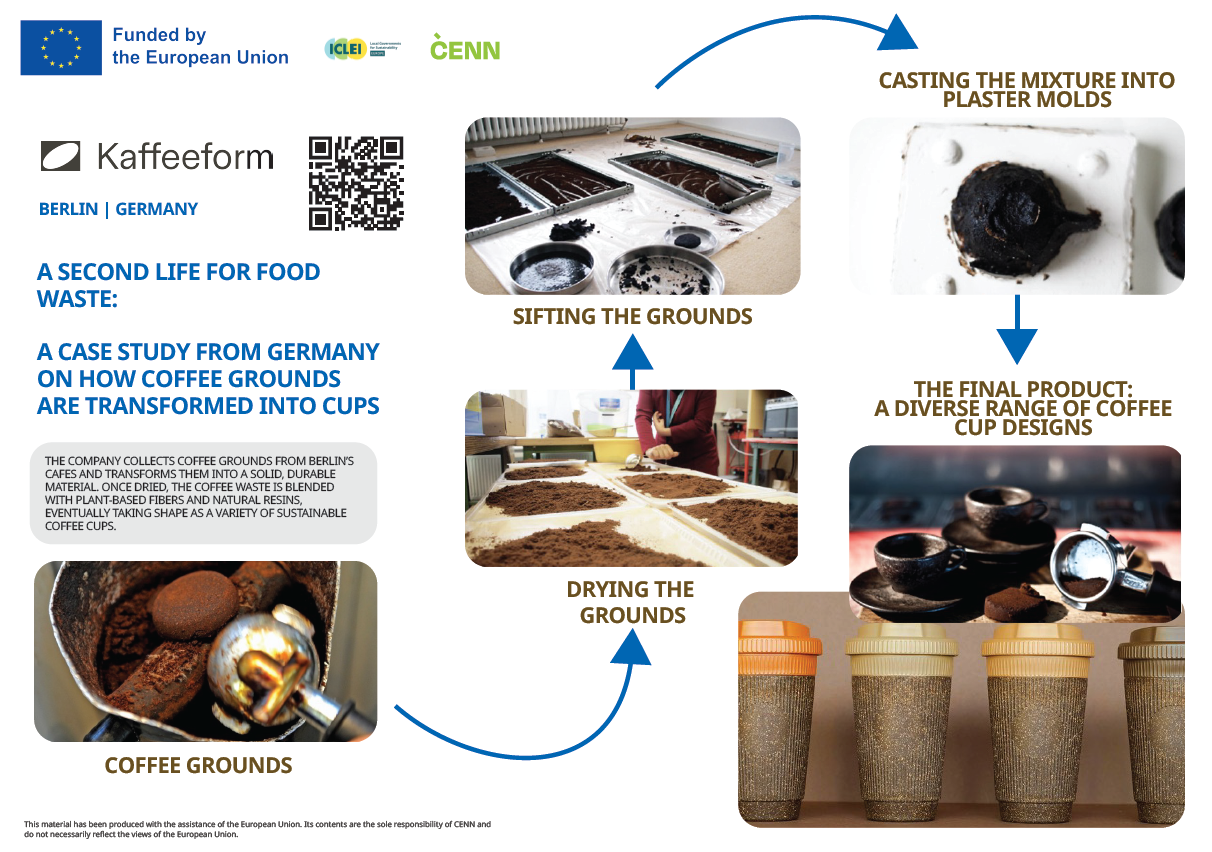
How Do Coffee Grounds Become Cups?
The process begins with collecting used coffee grounds from cafés in Berlin. The collected waste is specially dried and then mixed with plant fibers and natural resins. The resulting blend is transformed into a solid, durable material, which is used to produce reusable coffee cups.
Kaffeeform’s products are not only practical and durable but also stand out for their contemporary design. One of the company’s most well-known lines, the Weducer cups, is a great example of how sustainability and aesthetics can be combined in a single product.
Why This Matters
Single-use paper and plastic cups represent a serious environmental problem today. Although paper cups are often perceived as an eco-friendly alternative, most of them are lined with a polyethylene layer on the inside, which makes recycling difficult. As a result, billions of cups end up in landfills every year.
Kaffeeform’s reusable cups offer a sustainable alternative to this problem. By reusing coffee waste, the company reduces food waste, promotes efficient resource management, and at the same time provides consumers with a practical and long-term solution.
A Second Life for Food Waste
The example of Kaffeeform clearly demonstrates that food waste can become the foundation for innovation and business development. By turning waste into a valuable resource, the company is setting a new standard in the packaging sector and showcasing a real pathway for the development of the circular economy.
A sustainable future often begins with a simple idea – seeing waste not as a problem, but as an opportunity.