Transforming Agricultural Waste into Interior Objects: How Designer Items Are Made from Rice Straw
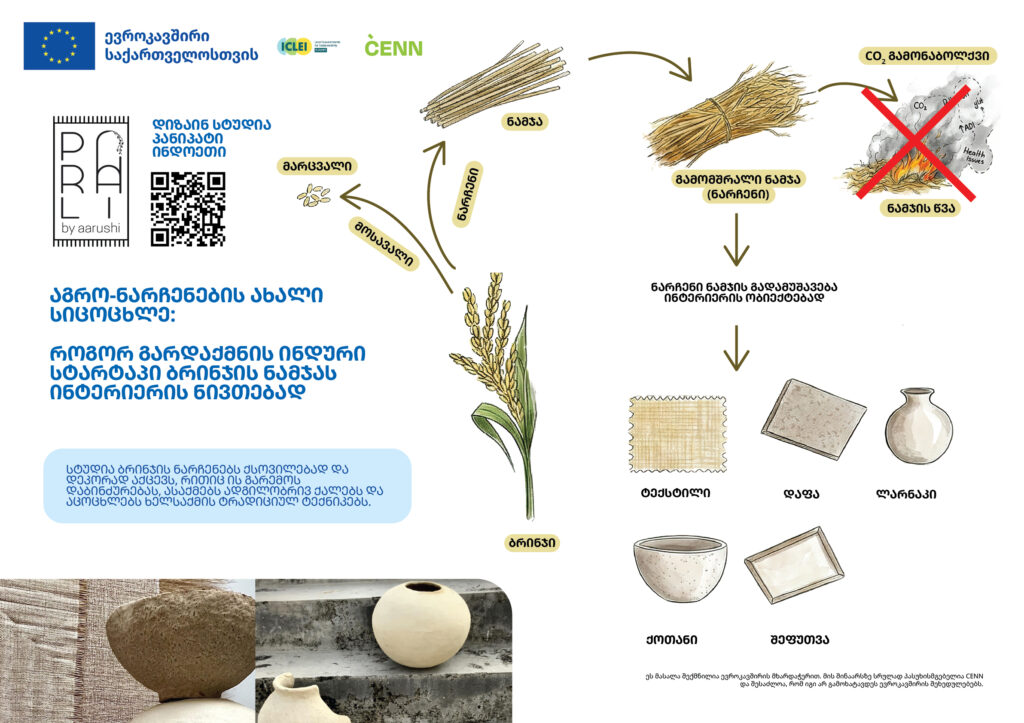
In India, after the rice harvest, large amounts of rice straw remain on agricultural fields each year, locally known as “Parali.” Burning it to prepare the land quickly is a widespread practice. However, despite its efficiency, this method has serious environmental and social impacts, contributing to air pollution, higher greenhouse gas emissions, and worsening health for nearby communities.
Parali-ის ცირკულარული პროექტი
As an alternative to this practice, the PARALI project offers a different approach in which agricultural waste is no longer seen as a problem, but as a potential resource. By collecting and processing rice straw, the project produces biodegradable, handmade decorative items and lightweight tableware. This method of crafting objects from natural materials challenges the linear “take-make-dispose” economic model and clearly demonstrates that with smarter resource use, it is possible to prevent waste and avoid its negative impacts. Moreover, it can create a new income opportunity.
Local Design
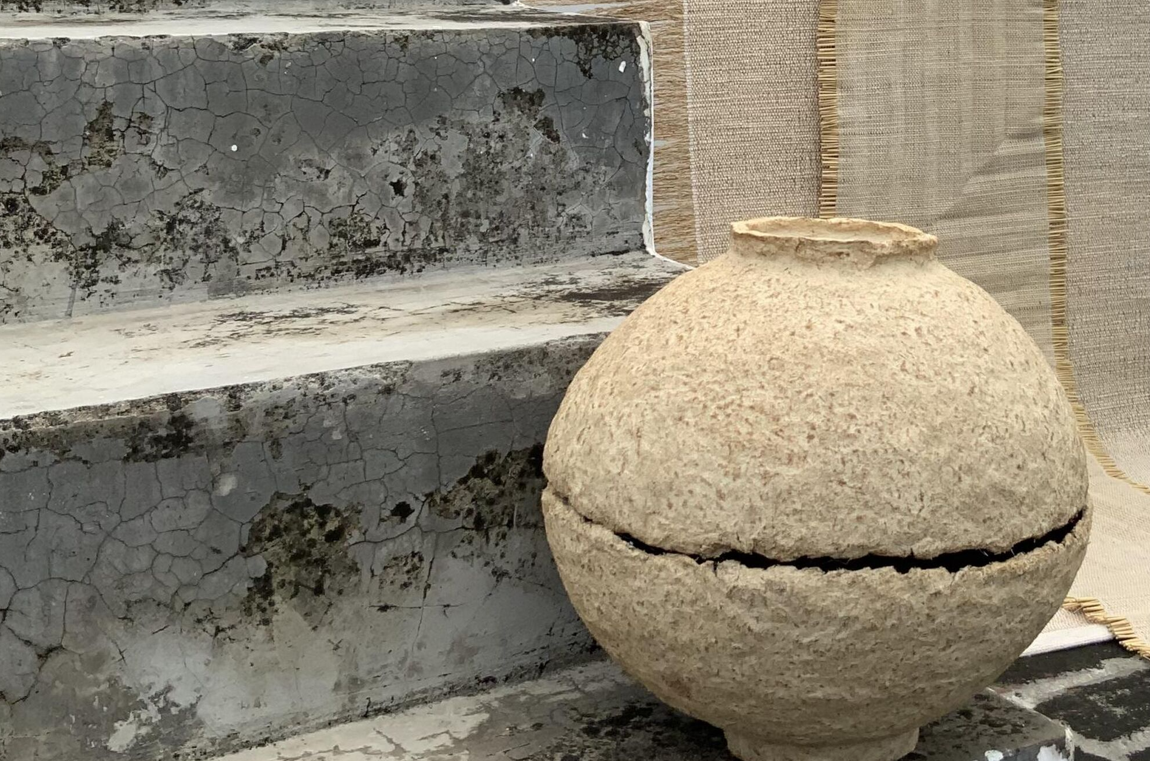
The PARALI approach is based on integrating local knowledge with contemporary design. With the involvement of rural women artisans, environmentally sustainable products are created that preserve elements of traditional craftsmanship and bring local cultural heritage to life in a new context. Rice straw is used as both a visual and structural element, meaning the product’s texture and form are shaped by the material’s natural characteristics.
Handwoven textiles are produced on traditional looms, with the design taking shape during the making process. Ornaments and details are inspired by agricultural landscapes and the rice-growing cycle, giving each product a distinct meaning. In this process, design serves not only an aesthetic purpose but also acts as a vehicle for social and environmental values. At the same time, integrating local knowledge with contemporary design connects the preservation of cultural heritage with the creation of environmentally sustainable products.
Environmental and Social Benefits
PARALI’s business model improves environmental conditions in two ways. Burning rice straw in India is a major driver of seasonal smog. By diverting this residue into production, the company helps reduce air pollution. In addition, transforming straw into natural, biodegradable materials (such as textiles and interior objects) reduces demand for synthetic and non-renewable resources, which in turn supports more responsible resource use across the entire value chain.
PARALI’s approach is built on engaging local communities. The project works with rural women artisans, strengthens their professional skills, and creates economic opportunities by revitalising traditional craftsmanship. This practice clearly shows that sustainability in a circular economy is not only about technical solutions, it also includes social dimensions related to people, livelihoods, and justice.
Circular practices do not always require high-tech systems or complex infrastructure, they are often built on simple principles:
- Design that considers every stage of a product’s life cycle
- Community-based collaboration models
- Simple, adaptable production
- A shift toward regenerative approaches
Scaling Up Circular Practices
Although PARALI is tailored to a specific regional context, the idea behind it is universal and can be easily adapted to conditions in other countries. Agricultural waste is a shared challenge for many nations, but it is also a resource that can be transformed into useful products with a low environmental footprint. With the right policies, market access, and increased awareness, similar initiatives can become an important tool both for reducing waste and for strengthening local economies.
For countries such as Georgia that are advancing circular development agendas, the PARALI case demonstrates how integrating agricultural residues, traditional knowledge systems, and innovative design can enable the development of practical and scalable models for resource-efficient production.