
Our world is replete with items that, upon consumption, frequently wind up in landfills. Owing to their composition, they remain in the soil for many years, polluting the environment and jeopardizing human health. This is where the concept of a circular economy comes into play, signifying that a product is repurposed and transformed into a new resource, rather than discarded as worthless waste once its life cycle has ended.
The R-strategy, which is one of the key principles of the circular economy, is an effective instrument for rethinking the different stages of product creation, including design, consumption, and end-of-life phases.
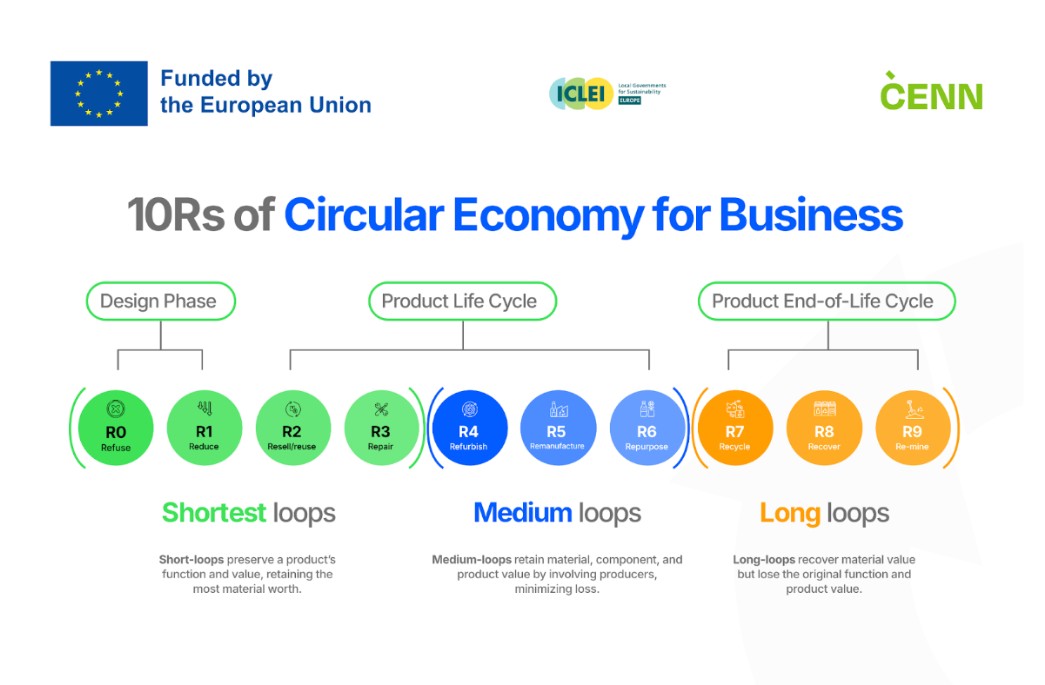
The R-Strategy comprises 3 cycles and 10 essential principles. Introducing and elucidating these principles is the primary goal of the article.
Short Loops – From Refusal to Repairability
Short loops are where a product maintains its most valuable state and functionality until the very end. The cycle involves only minimal alterations to the product’s original state, and at the final stage of the life cycle, the product is repaired, thereby refusing the utilization of new resources. This cycle consists of the subsequent four stages:
Refuse
This phase emphasizes the roles of both the consumer and the producer in a circular economy strategy. ‘Refuse’ means complete abstention from consumption, hence preventing waste generation and eliminating the need for new resources. Regarding production, the ‘refuse’ phase entails recovering and reusing existing resources to produce new materials while refusing to utilize new resources.
Reduce
This objective can be achieved by both the consumer and the manufacturer. The consumer can minimize the use of the product. The manufacturer can use less material during the product design and develop a strategy to prevent the use of environmentally harmful materials.
Resell/Reuse
This phase involves reintroducing a used product into the market following reprocessing and modifications. Typically, in this case, the product functions as a new one, and the consumer does not experience any discomfort or inconvenience due to its “second-hand” status. This is entirely determined by the manufacturer.
Repair
We tend to discard items too quickly. We hastily throw them away even when they sustain minor damage. Nevertheless, this circular economy strategy teaches us not to rush but to reconsider our disposal practices. By fixing or replacing faulty components, we can repair a product. The responsibility for this can be assumed by both the manufacturer and the consumer who purchased the product.
Medium-Long Loops – from refurbishing to repurposing products
These loops are predominantly business-driven and encompass strategies addressing the restoration or modification of product functionality. The medium-long loops preserve the value of materials, components, and products by engaging manufacturers and reducing waste. This cycle consists of the following three stages:
Refurbish
The phase involves replacing various components of a product or completely redesigning it while preserving the basic structure. This strategy usually yields an improved iteration of the original product that exhibits greater durability and reliability.
Remanufacture
Remanufacturing is an industrial process that involves the complete disassembly and reassembly of a product. This process aims to extend the item’s usable life while minimizing waste generation.
Repurpose
This strategy involves adapting a product so that its components serve entirely different functions. There are numerous instances of product transformations, such as turning glass bottles into mugs, etc. The repurposing strategy introduces a new life cycle to a product’s lifespan. This phase is often employed in creative industries.
Long Loops – from recycling to re-mining materials
These loops are typically part of waste management and involve the transformation of original products and materials. The long loops recover the material’s value, but the product’s original function and value are lost. This cycle comprises the following three stages:
Recycle Materials
Recycling refers to creating new raw materials from used products or production waste. This frequently requires complex technologies and results in secondary materials that lose the product’s original structure and function.
Recover
This strategy typically involves capturing energy from waste through incineration or biomass conversion. This energy can then be used to generate electricity or heat.
Re-Mine
The re-mining stage involves extracting valuable materials from waste deposits or landfills. Although it is still less common and mainly applies to areas with an economic need for re-extraction, technological progress may increase its significance in future circular strategies.
Ultimately, 10R strategies can be divided into three broad categories: user choices, business involvement in product upgrading, and material-level processes. Successful transition to a circular economy requires altering both the mindsets of producers and the behaviors of consumers.
By implementing these strategies, not only can we protect our planet, but we can also open up new economic opportunities and stimulate innovation. Understanding and adopting the 10R strategies will help us create a better future, where nothing is wasted and all products are repurposed, leading to a sustainable, circular economy that safeguards human well-being while emphasizing the significance of preserving the natural environment.